

👋 Hey there, I’m Illai. Every day, I share with readers questions, insights and learnings about startups, venture capital, Artificial Intelligence and entrepreneurship. You can find more about what I do and write about here: Illai’s Linkedin | My Website | Fundraising with AI Workshops | ZIZO Product Course | Between App
Paid Subscribers get exclusive access to more articles and insights, get an invite to my community and will get discounts for my online courses, workshops and advisory sessions.
Founders have a choice to make when they start a new AI company.
Many of the founders I meet just want to meet an AI company, mainly because it's hyped but there are many types of companies you can build in the landscape of AI.
First like before the age of AI, you want to tackle big problems and big markets if you want to build a venture investable company, however, based on the problem you tackle and your own experience and persona I believe you need to make a founding choice:
1) Impact: building in the age of AI has an impact equation stuck to it and it's a net sum decision. You can build a company that will require heavy training of foundational models, and that will need big investments of capital but maybe also an environmental cost. There is no black or white, but there is a net sum equation of impact. You might need to require immense amount of compute power and energy, but that will have social impact of bringing financial education for the masses.
2) Scientific and non-scientific: You can build a massive company with AI that does not require deep scientific research but maybe users and industrial research, however you can choose a problem and solution that will require you to build research teams, and labs. That will impact on the culture, who you hire to the company and the capital and type of investors.
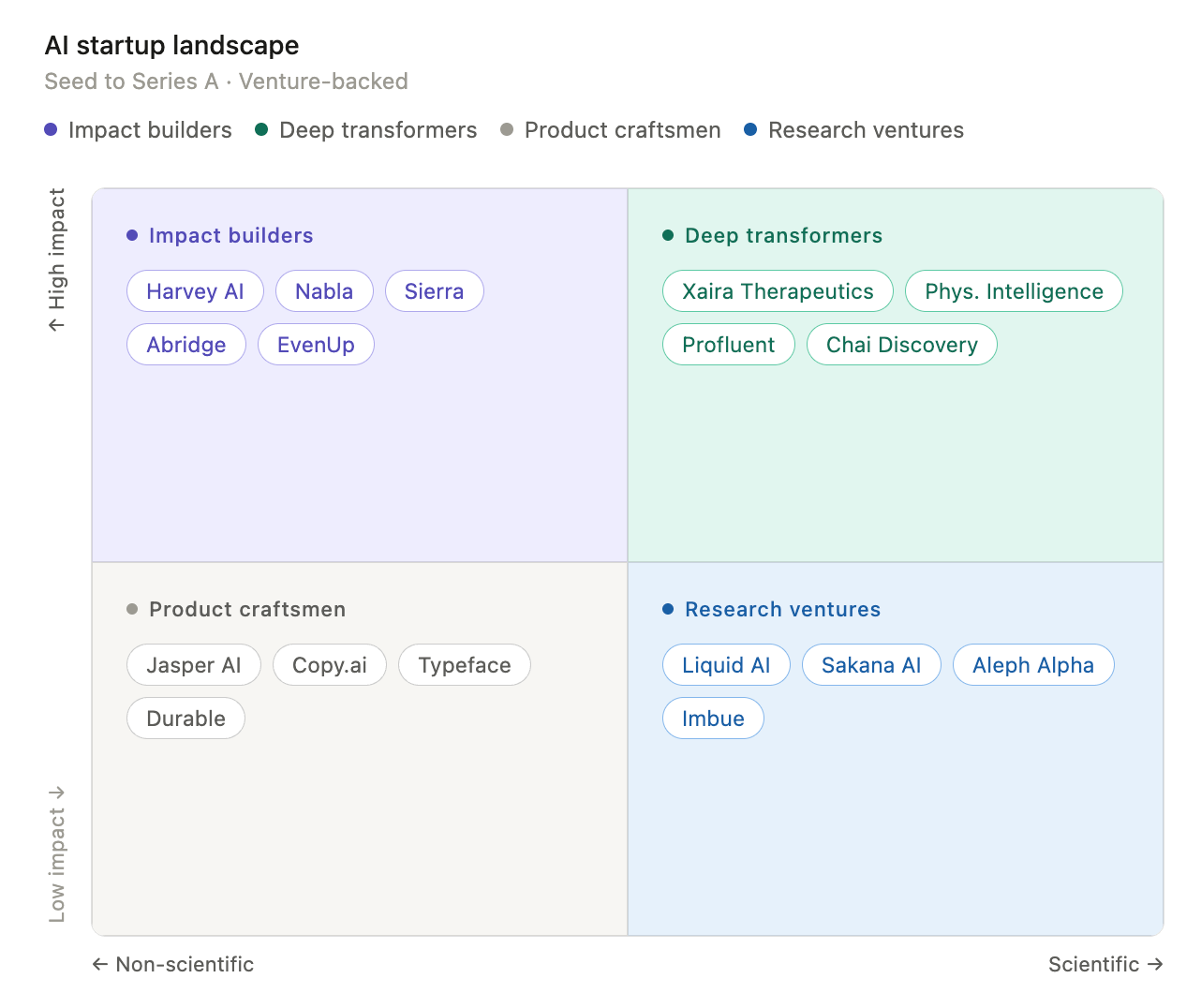
I asked Claude to create such a 2x2 chart for me, and place leading companies in the seed-A stages, which are venture backed.
Claude created 4 categories:
1) Impact builders: non-scientific but high-impact. It gave the example of Harvey in the legal tech space or Sierra in enterprise. They transform known commercial processes disrupting inefficiencies in different industries.
2) Deep Transformers: Scientific and high-impact. These companies would typically require research teams with very specific research experience, massive rounds of capital, and it will take time to see any revenues. It gave examples of Xaira Therapeutics in drug discovery and Profluent in protein design.
3) Product Craftsman: Non-Scientific and lower transformative impact. These are the usual use cases we all think of in AI such as productivity tools. In those cases you might think of SaaS tools applying AI. It gave Jasper AI which allows you to create agentic workflow for your content marketing. Thos are great businesses but there is a risk of crowded markets and commoditisation.
4) Research Ventures: Scientific but low scale impact. This is the most difficult part of AI companies with research that might have breakthrough results but the path for scalable and fast impact on society and the environment might not be well understood yet. It provided Skana AI which develops nature-inspired methods to advance cutting-edge foundation models.